 Mon – Fri: 07:00 AM – 05:30 PM
 2880 Acton Road Suite A Birmingham, AL 35243
 (205) 380-2884

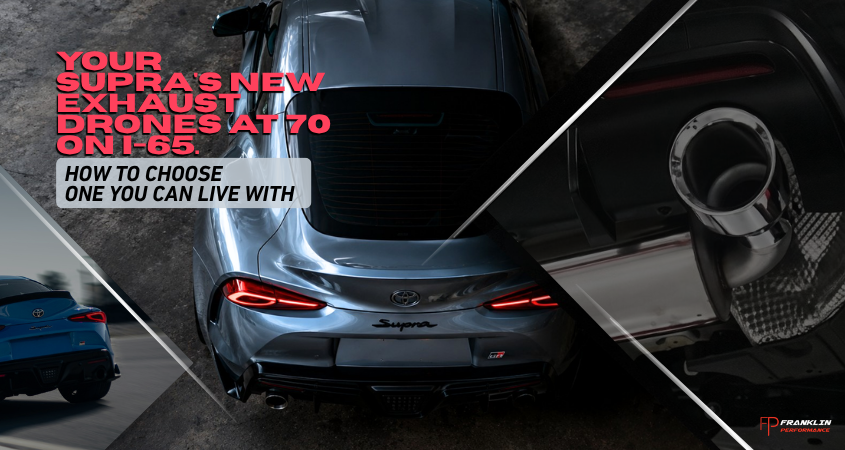
An aftermarket Mk5 Supra exhaust that sounds perfect at full throttle can turn into a steady, head-filling hum at 70 mph. That hum is drone. It comes from one narrow band of engine speed, and with many aftermarket systems that band lands right where you cruise on I-65 between Birmingham and Montgomery. Holiday trips make it obvious. Ninety minutes of it wears you out. If you’re planning spring mods over the winter, choose the exhaust for the hours you spend cruising, not the seconds you spend at full throttle.
Quick Summary: Key Takeaways
- Drone is resonance: one engine speed makes the cabin hum.
- Straight-through systems drone most: less muffling means more of that frequency reaches the cabin.
- Resonated or valved is the daily-driver pick: full sound under load, far less hum at cruise.
- Alabama law applies: a muffler without baffles is illegal on a highway here.
Exhaust Drone Is a Cruise-Speed Resonance
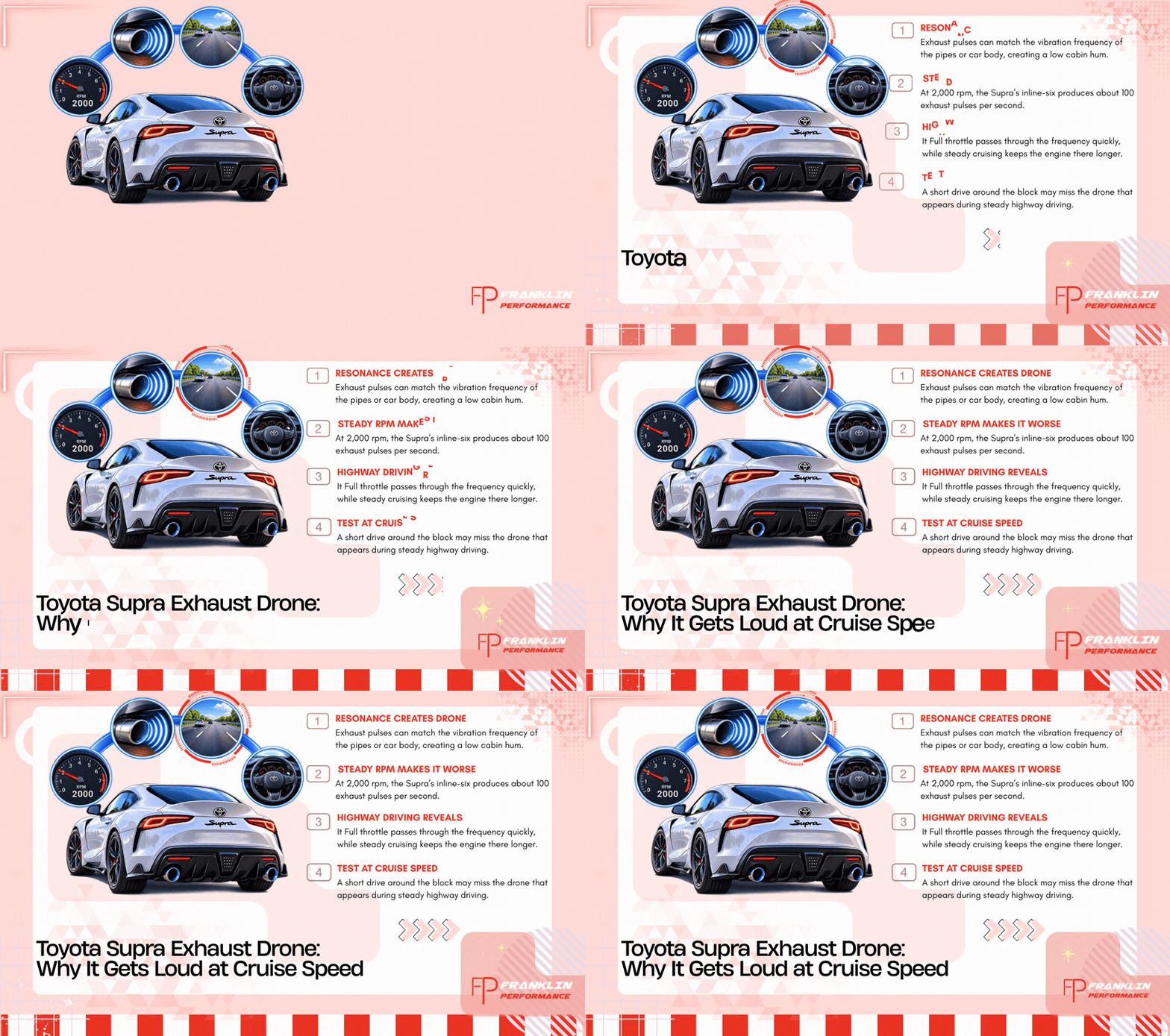
Drone happens when the exhaust’s pulse frequency matches something in the pipes or the body and both start vibrating together. The 3.0’s inline-six, like any four-stroke six, fires three times per crankshaft turn. So at 2,000 rpm the exhaust pulses about 100 times a second, a low note your ears register as pressure as much as sound, and an open system lets it straight into the cabin.
Full throttle sweeps through that frequency in a second or two, but cruise control parks the engine right on top of it for an hour at a stretch. A test drive around the block tells you almost nothing.
What a Mk5 Supra Exhaust Replaces From the Factory
The stock car is smarter about sound than most owners realize. Toyota rates the 2025 GR Supra’s turbocharged inline-six at up to 382 horsepower and 368 lb-ft of torque, fed through a dual-branch exhaust manifold. Toyota Canada’s 2025 release lists dual rear sport exhaust outlets with an active exhaust function, plus active sound control on the engine.
So part of what you hear inside a stock Supra is managed, and the active exhaust function lets the car open up or quiet down. Swap in a straight-through cat-back that ignores that logic and the quiet setting is gone.
Resonated and Valved Systems Are the Ones You Can Live With
Pick by where you drive, not by sound clips. A resonated cat-back uses chambers to cancel the drone band while leaving the rest of the note alone, and it’s the right call for a Supra that does Birmingham commutes, Gulf Coast trips and the odd back-road weekend. A valved system goes further. Closed at cruise, it routes gas through the mufflers; open, it sounds the way you paid for.
A non-resonated, straight-through system belongs on a car that mostly lives on a trailer. Delete the mufflers entirely and you have a legal problem too. Alabama’s muffler law, on the books since 1927, requires a working muffler on every vehicle and rules out cut-outs, bypasses and baffle-free mufflers on the highway. Keep the mufflers.
A Downpipe Changes the Sound More Than Owners Expect
A downpipe sits ahead of the cat-back and changes the whole note, drone included. High-flow ones keep the catalytic converter. Expect more volume and rasp. Catless ones add more of both. They also mean the car no longer meets emissions standards, which is reason enough to skip them on a street car.
If a downpipe is on the spring list, choose the cat-back with it in mind. A system that hums gently on a stock downpipe can drone hard once the front section flows more freely. Plan both parts together.
Use the Holiday Drives as Your Test
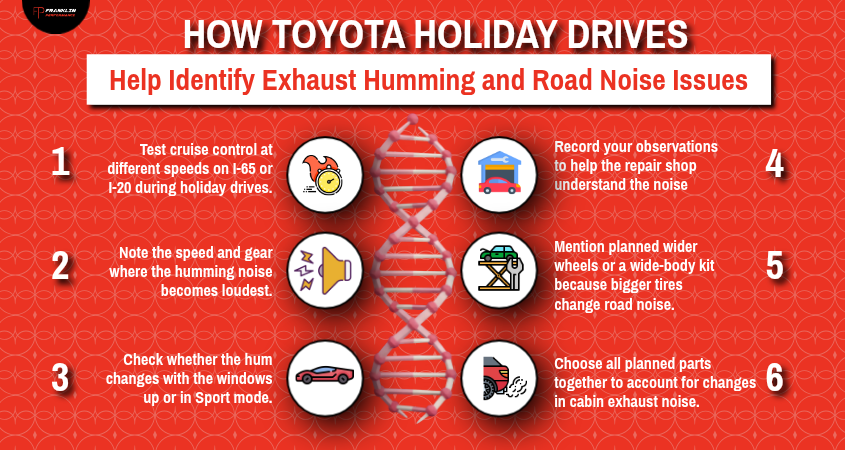
November and December give you the perfect trial. Try the cruise control at a few different speeds on I-65 toward Montgomery or I-20 toward Atlanta, and note the speed and gear where the hum peaks. Is it worse with the windows up? Worse in Sport? Write it down.
Your own notes, from your car on your roads, will tell a shop more than a forum video. If wider wheels or a wide-body kit are also in the plan, mention it, because bigger tires change road noise and that changes how loud the exhaust seems in the cabin. Pick every part at once.
How Franklin Performance Fits an Exhaust You’ll Keep
The shop’s advice is plain. Match the system to the driving, because some exhausts are built for racing and don’t suit a car that commutes. Loaner cars and a shuttle cover the day your Supra is on the lift, and financing is available for a bigger spring build.
Toyota is on the shop’s tuning list, so an exhaust and a tune can be planned as one build. Talk it through first. The shop’s own Supra page makes the same point about any modification.
Frequently Asked Questions
Q: Why does my Supra exhaust drone on the highway?
A: At steady cruise the engine sits on one speed, and the exhaust pulse frequency at that speed makes the pipes and body resonate. Straight-through systems with little muffling let more of it into the cabin.
Q: Is a valved exhaust worth it on a Mk5 Supra?
A: For a car you drive daily, yes. Closed at cruise it stays quiet, and open under load it gives you the full sound.
Q: Can a resonator stop exhaust drone?
A: Mostly, yes. A resonator tuned to the drone band cancels much of it, which is why a resonated cat-back usually cruises far quieter than a straight-through system with the same pipe size and the same tips.
Q: Is a muffler delete legal in Alabama?
A: No. Code of Alabama section 32-5-216 makes a muffler in good working order mandatory, so removing it, or fitting an empty can in its place, breaks state law on any public highway.
Pick the Exhaust Before the Spring Build Starts
Bring your holiday-drive notes: the speed, the gear and how bad the hum got. Send them ahead through the request form on franklin-performance.com, so the conversation starts from your numbers instead of a sound clip. Then bring the Supra to Suite A, 2880 Acton Road, Birmingham, AL 35243, before any parts are ordered.