 Mon – Fri: 07:00 AM – 05:30 PM
 2880 Acton Road Suite A Birmingham, AL 35243
 (205) 380-2884

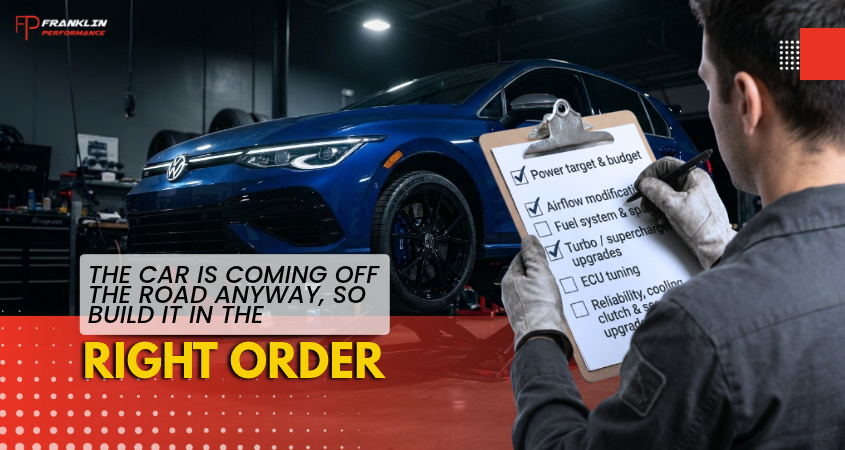
A Golf R comes into the shop with a list. The owner wants more power by spring, he has six parts picked out, and he has no idea which one to start with. That conversation happens several times every fall, and the list is almost never the problem — the order he plans to work through it is.
Winter is the sane time to do this work in Birmingham. Travel on all U.S. roads in December 2025 came to 265.8 billion vehicle miles, and seasonally adjusting that same month lifts it to 277.2 billion, by the Federal Highway Administration’s monthly count — December runs about four percent under a normalized month, and most of the difference is trips nobody misses. If a car is going to sit for six weeks, it may as well sit on a lift.
Decide the power target before you buy one part
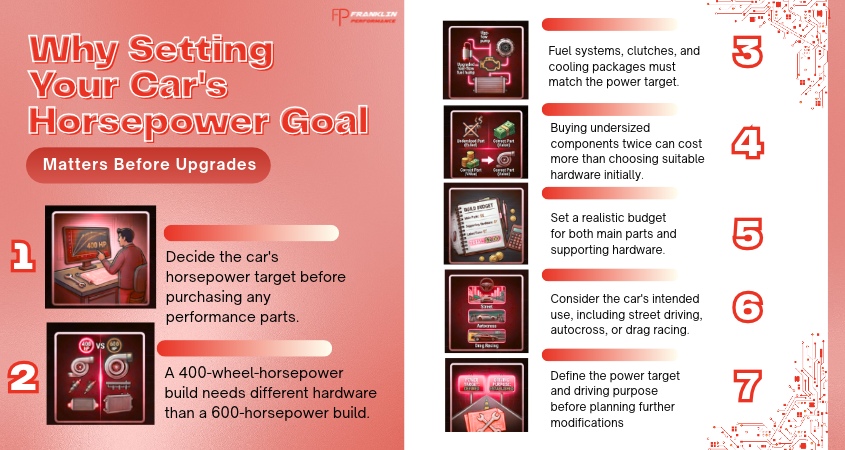
Every sequencing argument ends the same way, and it ends there because the target decides the hardware. A car aiming at 400 wheel horsepower and a car aiming at 600 do not share a fuel system, a clutch or a cooling package, and buying the 400 version twice costs more than buying the 600 version once.
Budget honestly at this stage as well. A build where the owner spends everything on the headline part and nothing on the supporting hardware is the one that comes back in April on a flatbed, and we would rather talk about that in November than explain it in the spring.
Write the target number down, then write down what the car is for — street miles on I-65, an occasional autocross, a drag strip twice a year. Those two lines settle most of what follows and they settle it without an argument.
Airflow comes first because everything else reacts to it
Intake, downpipe and exhaust change how much air the engine can move, and every calibration decision afterward depends on that number. Doing them last means paying for a second flash.
There is a practical reason to do them first too. Exhaust and downpipe work is where fitment surprises live: a hanger that fouls, a sensor bung in the wrong place, a flange that needs a spacer. Finding that in December costs a Saturday. Finding it the week before a spring event costs the event.
Fuel and spark come before boost, every time
More air without more fuel is a lean condition, and a lean condition at full boost is how pistons get holed. The pump, the injectors and the plugs are not the fun part of the list, and they are the part that decides whether the fun part survives.
Order of operations we use: confirm the pump has headroom at the target, check injector sizing against it, then gap the plugs for the pressure the engine will actually see. Those three together usually cost less than the turbo and they protect it.
Forced induction is a lead-time problem, not a labor problem
A turbo or supercharger upgrade is mostly a parts-availability exercise. Housings, manifolds and intercooler cores for European platforms get backordered, and the backorder does not announce itself until the part is already in a cart.
That lead time is the single best argument for starting in November instead of February. Order early, let the box sit on the shelf, and the install happens on your schedule. We would rather hold a part for six weeks than tell somebody in March that the car is apart and the manifold is in a container.
The software goes on last, onto finished hardware
We run pre-mapped software, beta tested and proven on the platform before it reaches your car, and a Stage 1 flash is quick enough to do while you wait. None of that is an argument for doing it early.
Flash a file onto a car that still has three parts coming and you have paid for a calibration written around an airflow figure the car is about to stop producing. Finish the hardware, then flash it, and the file matches what the engine is actually doing. Put the software at the end of the list even though it is the shortest job on it.
What we would leave alone until the car runs
Wheels, cosmetics and interior work are easy to slot in while the car is down, and they are also the items most likely to eat the budget that the fuel system needed. Our advice is to finish the powertrain, drive it for a month, then spend what is left.
There is one exception worth making. If the car is already apart for the turbo and a cooling or clutch item is right there behind it, do it then. Labor overlap is real money, and paying twice to remove the same bumper is the kind of thing that makes an owner resent a build.
Where a Winter Build Starts With Us
If the plan is a spring car, November and December are when the decisions are cheap and the shelves are full. Franklin Performance is at 2880 Acton Road, Suite A in Birmingham, and the full list of what we do is at franklin-performance.com.