 Mon – Fri: 07:00 AM – 05:30 PM
 2880 Acton Road Suite A Birmingham, AL 35243
 (205) 380-2884
You spent real money making your car faster — an ECU tune, a cold-air intake, maybe a bigger turbo — and all spring it pulled hard. Then Birmingham hit 95 degrees and it went soft. That’s not your imagination, and the tune didn’t go bad.
It’s heat soak. Every modified car fights it once an Alabama summer sets in, and the more power you’ve added, the more you feel it. At Franklin Performance, dialing builds back in for the heat is a big part of what we do this time of year — because a fast car that can’t stay cool isn’t fast in July.
Quick Summary: Key Takeaways
- Hot air makes less power: Less-dense summer air carries less oxygen, so an engine loses roughly 1% of power for about every 10°F rise.
- Heat soak is the summer enemy: In traffic, intercoolers and intake temps climb fast, and your tune feels it first.
- Your tune protects itself: High intake temps make the ECU pull timing and boost to dodge knock — that’s the flat feeling.
- The fix is cooling, not more boost: A bigger intercooler, a sealed intake, or a heat-aware map beats cranking the tune.
- This is tuning work, not a tune-up: Datalogging intake temps and recalibrating is performance-shop territory.
Hot Air Simply Makes Less Power
Start with the physics, because it sets the ceiling for everything else. Hot air is less dense than cool air, so every intake stroke pulls in fewer oxygen molecules, and less oxygen means less power — an engine loses roughly 1% of output for about every 10°F the air warms up. On a 95-degree Birmingham afternoon versus a cool spring morning, that adds up fast. Real, measurable power, gone.
A naturally aspirated car feels it directly. A turbo or supercharged car can mask some of it by cramming more air in, but forced induction also makes its own heat — which is where the real summer trouble starts.

Heat Soak Is What Really Kills a Summer Build
Heat soak is the slow build-up of heat in the parts that feed your engine air. Roll hard once and the intercooler does its job. Sit at a light on Highway 280, then crawl through traffic, and there’s no airflow to carry that heat away — so the intercooler, the piping, and the intake all bake, and the air reaching your engine gets hotter by the minute.
That’s why the car feels strong on the first pull and flat on the third. The tune didn’t change. The air did.
Your Tune Pulls Timing to Protect the Engine
Here’s the part owners miss: a good tune fights back on purpose. When intake air temperatures climb, the ECU sees the higher risk of knock and pulls ignition timing — and often boost — to keep the engine safe. You feel that as a soft, lazy power band exactly when it’s hottest.
That’s the tune working, not failing. But it means the way to get the power back isn’t more aggression in the map — it’s giving the engine cooler air so it never has to pull timing in the first place.
The Fixes Are About Cooling, Not Cranking the Boost
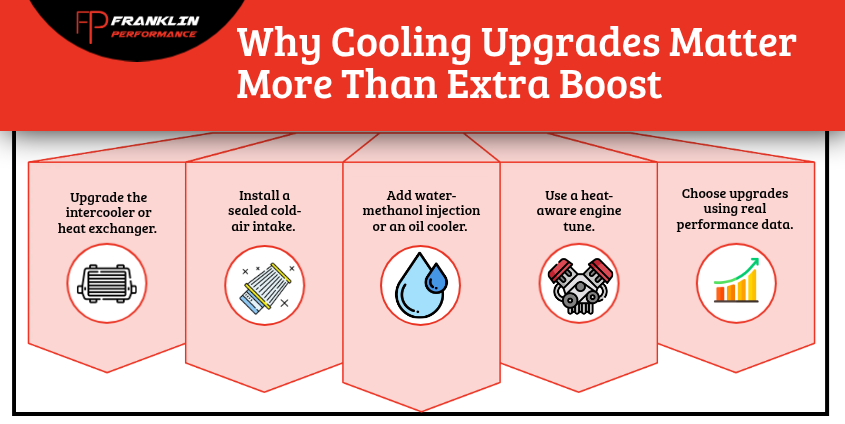
This is where a build gets its summer legs back. An upgraded intercooler or heat exchanger with more capacity sheds heat faster and resists soak in traffic. A properly sealed cold-air intake stops pulling in engine-bay heat. On the right platforms, water-methanol injection or an auxiliary oil cooler takes the edge off, and a heat-aware calibration keeps everything in a safe window.
None of it is guesswork. We log intake temps, timing, and boost, then choose the upgrade that actually moves your numbers — instead of throwing parts at the car and hoping.
Why This Is Performance Work, Not a Tune-Up
This is the line between us and a general repair shop. Chasing heat soak means datalogging a modified car, reading timing and IAT behavior, and recalibrating the ECU around real numbers — specialized tuning work, not a maintenance item. Our sister shop, Franklin Automotive, handles the everyday repairs; Franklin Performance is where the builds live. That’s our lane.
So if your car is modified and it’s gone flat in the heat, it belongs on a performance bench. That’s the whole point of the shop.
Why Birmingham Enthusiasts Bring Their Builds to Us
We tune and build the cars most shops send away — Audi and VW on platforms like APR, Unitronic, and Integrated Engineering, BMW including Dinan, plus the exotics. Our VW and Audi Master-certified team works from data, not hunches, and we’ll tell you straight whether your car needs a cooling upgrade or just a smarter map. Numbers, not guesses.
Bring it in before the worst of the summer. We’ll get the power back the right way.
Frequently Asked Questions
Q: Why does my tuned car feel slower in the summer?
A: Two reasons stack up. Hot air is less dense, so the engine makes less power to begin with, and then heat soak drives intake temperatures higher until your tune pulls timing and boost to protect the engine. The result is a car that feels flat exactly when it’s hottest out.
Q: What is heat soak and how do I reduce it?
A: Heat soak is heat building up in the intercooler, piping, and intake when there’s little airflow — like idling or crawling in traffic. You reduce it with a higher-capacity intercooler or heat exchanger, a sealed cold-air intake, and in some cases water-methanol injection, so the air reaching the engine stays cooler.
Q: Will a bigger intercooler actually help in hot weather?
A: On a forced-induction car, usually yes. A larger, more efficient intercooler sheds heat faster and resists soak in stop-and-go driving, which keeps intake temps down and stops the ECU from pulling timing. We confirm it with datalogging rather than assuming.
Q: Can you adjust my tune for summer heat?
A: Yes. A heat-aware calibration keeps timing and boost in a safe window as intake temps rise, and we pair it with the right cooling hardware for your setup. We log the car first so the changes are based on your actual numbers, not a generic file.
Get Your Build Ready for the Alabama Heat
Modified car gone soft in the heat? Bring it in and we’ll find the power the right way — with data, not guesses.
Franklin Performance — 2880 Acton Road, Suite A, Birmingham, AL 35243
Hours: Monday–Friday, 7:00 AM – 5:30 PM
Website: franklin-performance.com