 Mon – Fri: 07:00 AM – 05:30 PM
 2880 Acton Road Suite A Birmingham, AL 35243
 (205) 380-2884
Bentley builds its vehicles to a level of refinement that few manufacturers approach — but factory calibration is always a compromise, engineered to satisfy emissions regulations, warranty parameters, and the broadest possible range of driving conditions worldwide. For Bentley owners in Birmingham who want to extract more from the W12 or V8 platform already sitting beneath that beautifully sculpted hood, performance tuning offers a structured path from subtle refinement to substantial power gains. At Franklin Performance, we work with Bentley owners through all three tuning stages, and the conversation always starts with the same question: what exactly does each stage involve?
Stage 1: ECU Remapping Without Hardware Changes
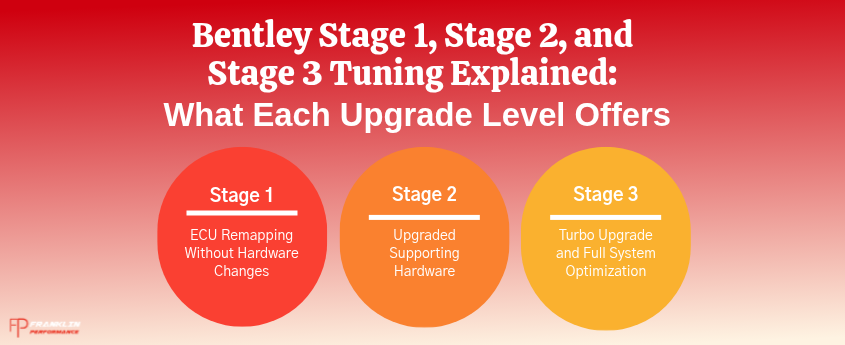
Stage 1 tuning is a software-only modification — no replacement parts, no hardware upgrades. A calibrated ECU remap adjusts the factory parameters that govern fuel injection timing, ignition advance, boost pressure (on turbocharged variants), and throttle response mapping. On a turbocharged Bentley like the Continental GT W12 or Flying Spur, the factory boost ceiling is set conservatively relative to what the engine internals and turbocharger hardware can physically support. A Stage 1 remap raises this ceiling within safe engineering margins while optimizing the air-fuel ratio across the rev range.
The gains from Stage 1 on a Bentley W12 are typically in the range of 40–70 horsepower and a comparable increase in torque, depending on the model year and base tune. The equally notable change is in how the power is delivered — throttle response becomes more immediate, the midrange torque curve fills in, and the engine feels more willing at partial throttle. This is the tuning stage most commonly chosen by owners who want a meaningful improvement without touching the hardware and want the modification to remain reversible.
Stage 1 requires an engine in good health — clean sensors, healthy injectors, and a turbo system without leaks or worn seals. Tuning a mechanically compromised engine amplifies existing stress rather than improving performance.
Stage 2: Upgraded Supporting Hardware
Stage 2 adds hardware components that allow the engine to sustain the higher demands of an aggressive ECU remap. The specific upgrades depend on the platform and what the factory hardware’s limiting factors are, but typical Stage 2 additions include a high-flow performance exhaust system, upgraded intercooler, or improved intake components.
On a Bentley W12, the factory intercooler is designed for the factory boost targets. At the elevated pressures of a Stage 1 remap, the intercooler can approach its thermal capacity under sustained hard acceleration — producing elevated intake air temperatures that the ECU compensates for by pulling timing, which reduces the realized gains. An upgraded intercooler allows the Stage 2 remap to maintain cooler charge air, letting the engine hold its optimized timing and boost levels more consistently.
Stage 2 power gains on a Bentley W12 typically reach 80–120 horsepower over stock, with improved consistency over back-to-back performance runs compared to Stage 1 alone. The exhaust modification also changes the acoustic character — Bentley’s factory exhaust is deliberately muted, and a Stage 2 exhaust system allows more of the W12’s inherent sound character to be heard, particularly under hard acceleration.
Stage 3: Turbo Upgrade and Full System Optimization
Stage 3 is a comprehensive powertrain performance package that typically includes upgraded turbocharger hardware in addition to the Stage 2 components. This level of modification is aimed at owners who want the platform performing at its absolute potential rather than extracting more from the factory hardware. Larger turbine wheels flow more air mass at a given boost pressure, allowing the ECU remap to target higher power levels without the thermal stress that simply raising boost on the factory turbocharger would produce.
Stage 3 on a Bentley W12 Continental GT can push well past 700 horsepower in appropriate builds. This stage requires a full assessment of the drivetrain — particularly the automatic transmission and driveline components — to confirm they can manage the increased torque. Stage 3 builds also typically require higher-octane fuel to realize the full remap benefit and prevent knock.
The trade-off at Stage 3 is that the modification is no longer easily reversed and the distance from factory engineering parameters is significant. Routine maintenance and inspection intervals should be shortened, and the build requires professional calibration specific to the actual installed hardware rather than an off-the-shelf map.
Why Tuning a Bentley Requires Specialist Experience
Bentley’s electronics architecture is complex, with multiple control modules in communication and active safety systems that interact with engine output. Applying a generic remap tool to a Bentley without understanding the full module communication environment risks conflicts with the stability control, transmission mapping, and traction control systems. Tuning at Franklin Performance is conducted with platform-specific knowledge of how Bentley’s systems interact, ensuring that the performance modifications complement rather than fight the vehicle’s existing architecture.
Contact Franklin Performance in Birmingham
If you’re interested in exploring Stage 1, 2, or 3 tuning for your Bentley Continental GT, Flying Spur, or Bentayga, contact Franklin Performance at (205) 380-2884 or visit us at 2880 Acton Road Suite A, Birmingham, AL 35243. We’ll assess your vehicle’s current condition and walk through the tuning path that fits your performance goals.
Frequently Asked Questions
Will Stage 1 tuning void my Bentley’s factory warranty?
An ECU remap is detectable by a dealership diagnostic scan, and many manufacturers will deny warranty claims on components directly affected by the tune. Whether your specific vehicle is still in warranty and how aggressively the dealer pursues this varies — it’s worth understanding your warranty status before proceeding with any tuning modification.
Can Stage 1 tuning be reversed if needed?
Yes. A Stage 1 remap can be reversed by restoring the original factory map, which reputable tuners retain as part of the calibration process. The ECU returns to factory parameters, though some flash event logs may remain detectable by dealer diagnostics.
Does Stage 1 tuning affect fuel economy?
It depends on driving style. The improved torque curve means the engine can achieve the same acceleration at lower throttle input, which at steady highway speeds can maintain or marginally improve fuel economy. Driving to exploit the additional power will increase consumption — the modification doesn’t improve thermodynamic efficiency, it shifts the power delivery envelope.
How long does an ECU remap take on a Bentley?
A Stage 1 remap is typically a two to three hour process including the pre-tune diagnostic inspection, the mapping session, and a verification drive. More complex Stage 2 and 3 builds that involve hardware installation require additional time for component fitting and iterative calibration.